
Julia sets, and the map of all of them
The rule has two numbers in it — the starting point and the constant — and that means there are two different questions you can ask of it.
The Mandelbrot set answers: vary , always starting from — which constants produce bounded orbits? That picture lives in the parameter plane: each pixel is a different rule.
A Julia set answers the opposite question: freeze one particular , and vary the starting point instead. Which beginnings survive under this one fixed rule? Now the picture lives in the dynamical plane:
(Properly, is the filled Julia set and the Julia set is its boundary — the rendered pictures show the filled set, so this guide says "Julia set" the way explorers do.) Every point of the parameter plane names an entire Julia set of its own — the Mandelbrot set is, in a precise sense, a map of all Julia sets.
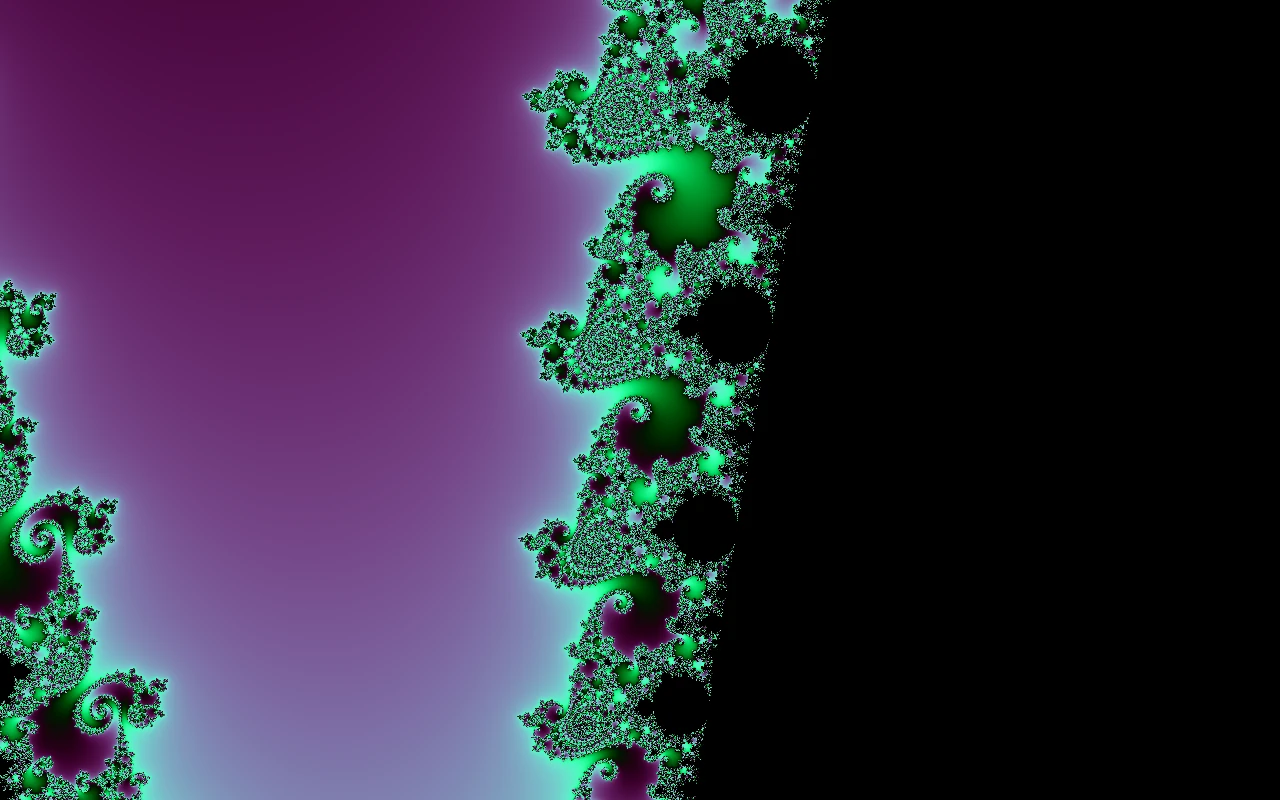
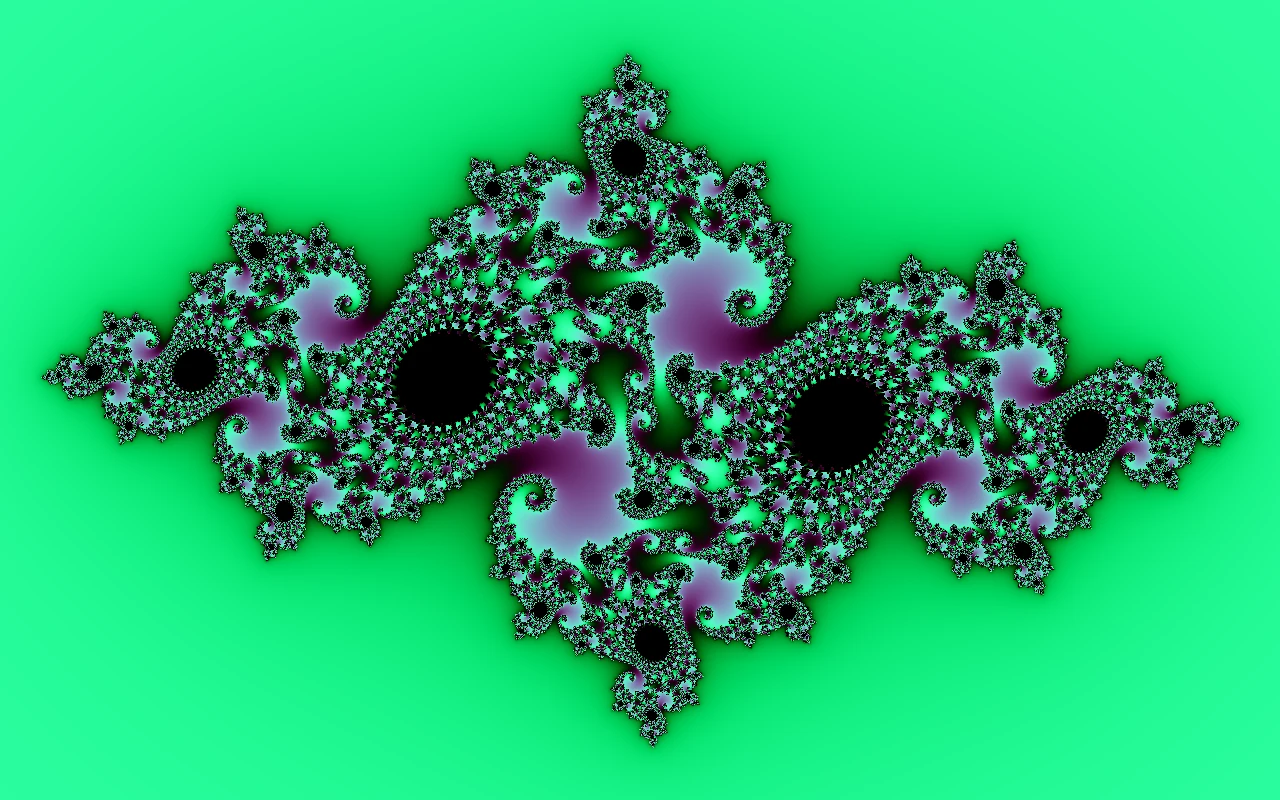
The map tells you what you'll find
The correspondence runs deeper than bookkeeping, and the reason starts with a question the Mandelbrot chapter left hanging: why must the orbit start at ? Because is the map's critical point — the one place where the derivative vanishes. A century-old theorem of Fatou and Julia says the critical orbit is the diagnostic orbit:
The Julia set of is connected — one unbroken shape — exactly when the orbit of the critical point stays bounded. If the critical orbit escapes, the Julia set shatters into a totally disconnected dust (a Cantor set) — no piece of it touches any other.
But "the critical orbit of stays bounded" is precisely the definition of . So the Mandelbrot set is not just an index of Julia sets — it is the answer sheet: choose from inside and its Julia set is connected; choose from outside and it is dust. There is nothing in between.
The inheritance goes further than connectedness. The richest Julia sets come from seeds near the boundary of , and they visibly inherit the character of their neighbourhood: a seed from Seahorse Valley gives a Julia set full of seahorse curls; a seed from a spiral region gives spirals. (This is no coincidence — and at one kind of boundary seed, the Misiurewicz points of the Mandelbrot chapter, it is a theorem of Tan Lei: there the Mandelbrot set and the Julia set are provably asymptotically similar.)
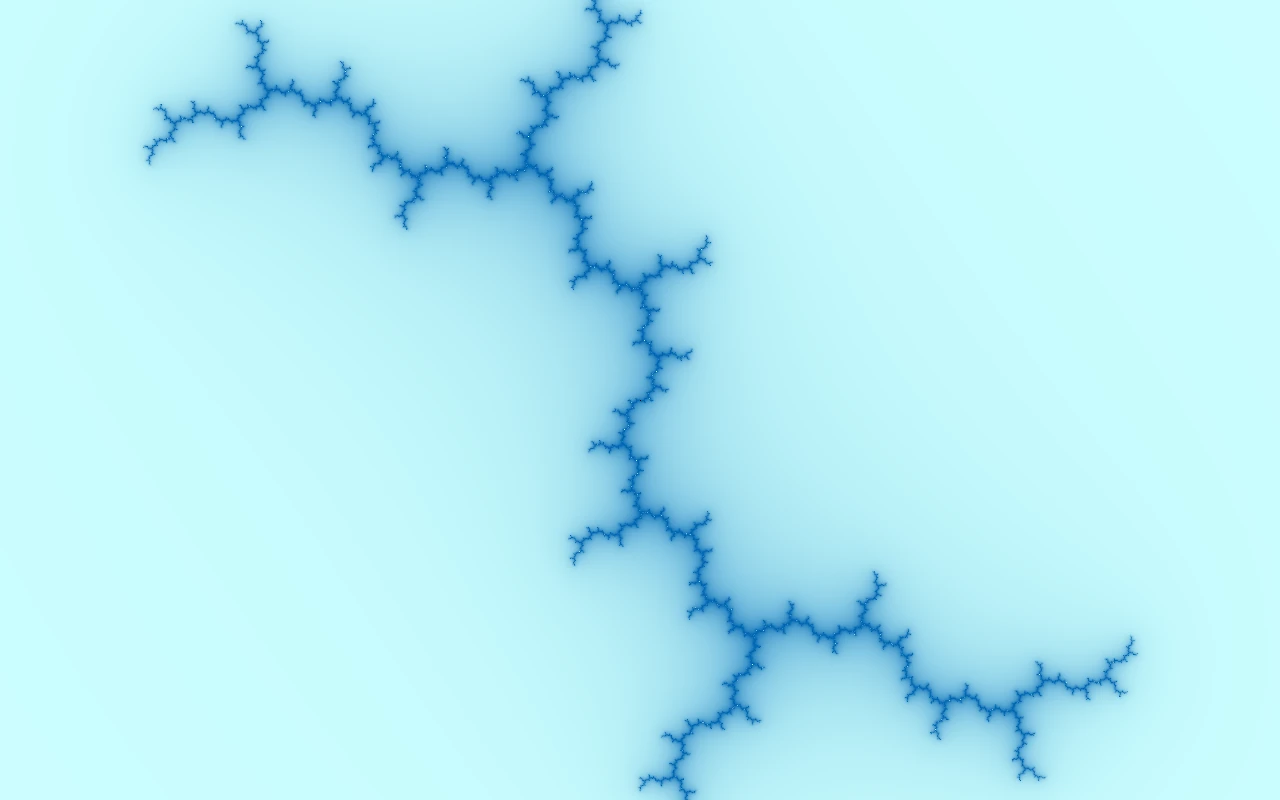
Exactly on the boundary, stranger things live. The worked orbit of the Mandelbrot chapter showed is a Misiurewicz point — bounded, but only just: its Julia set is the dendrite above, a shape with branches but no interior at all, the connected case pushed to its skeletal limit.
A field guide of seeds
Some Julia sets are famous enough to have names. Every row is one click away in the explorer — enter the seed via Locations → "go to a coordinate", or Alt-hover it on the Mandelbrot map:
| Seed | Name | Where it lives, what you get |
|---|---|---|
| Basilica | Centre of the period-2 bulb (exact): two-lobed, orbit beats . | |
| Douady rabbit | Centre of the biggest period-3 bulb: three ears repeating everywhere. | |
| San Marco | The exact pinch-point between cardioid and period-2 bulb: domes and spires on a razor's edge. | |
| Airplane | A period-3 minibrot's centre out on the real antenna: swept-wing crosses. | |
| Dendrite | Misiurewicz point (exact): pure branches, no interior. | |
| (dust) | Just outside on the real axis (the critical orbit escapes slowly): a Cantor dust that almost holds together. |
The pattern to notice: seeds at bulb centres give sturdy, thick Julia sets (their orbits are superattracting); seeds at boundary pinch-points and Misiurewicz points give the filigree; seeds outside give dust — finer and more structured the closer to the boundary you choose them.
Try it in the explorer
Mandala keeps both planes one gesture apart. In the parameter plane, hold Alt (or long-press on touch) and a small inset previews the Julia set for the under your pointer, live; click to commit and the view opens that Julia set for real. In the Julia plane, the same inset flips around and becomes a locator showing where your current seed sits on the Mandelbrot map. Every escape-time family here has both planes — Burning Ship Julia sets are just as real as Mandelbrot ones, and far less travelled.